

“I think this will work” can be a starting point. The difficulty appears when that opinion remains the only explanation after spending time, money and the team's attention. Having implemented an idea does not, by itself, mean that you have learned something about it.
I prefer to turn the conviction into a question that can be examined. That lets the person proposing the experiment and the person evaluating the result discuss the same issue. The conversation becomes less dependent on how confidently each person defends their preference.
Start with the decision the experiment should help you make
The experiment should clarify an identifiable decision, such as keeping a message, changing a purchasing step or allocating resources to an offer. Write down what you still do not know and why that uncertainty matters. An excessively broad question allows almost any result to be interpreted as confirmation of the original idea.
Imagine a service page that receives visits but generates few suitable enquiries. “We need to improve marketing” does not define an experiment. A more specific question would be whether explaining the service's scope more clearly helps potential clients recognise when requesting a conversation makes sense.
In this hypothetical example, the hypothesis connects a change with an expected behaviour. The explanation of scope is the change; the suitability of incoming enquiries is one relevant observation. More enquiries may be interesting, but you also need to understand whether they match the service you can deliver.
The diagnosis that comes before a marketing plan helps you choose that uncertainty. If you still do not understand the offer, delivery capacity or purchasing journey, you may be testing an explanation for the wrong problem.
Also write down what you would do with different answers. If the message becomes clearer but enquiries remain unsuitable, you may need to investigate where visitors come from. This preparation makes the test more useful than a change whose only acceptable outcome would be somebody saying they liked it.
To prepare your next step, explore Validating business ideas.
Record the starting point and what the measures mean
Before changing anything, save the initial situation and define exactly what you will count. A measure only supports comparison when its meaning remains consistent. Dates, contact sources, suitability criteria and recording methods help you understand whether you are observing a real difference within the same process, under conditions that can be examined.
In the service page example, a submitted enquiry differs from a meeting that actually takes place. A completed meeting does not demonstrate that the person has the need, conditions or interest required to become a client. Choose the stage that answers your question, retaining access to earlier stages to understand the journey.
Avoid using totals alone without understanding the opportunities to generate those results. Receiving more enquiries during a period with many more visits does not, on its own, establish that the page improved. Record changes in where those visits came from, because different audiences may arrive with different intentions.
Check that recording works before starting. A form that stops saving enquiries, or a definition of suitable contact that changes halfway through, can make the comparison unhelpful. If you discover a failure, note when it happened and which information was affected.
You do not need to collect every available measure. Keep those that answer the question and identify relevant alternative explanations. Adding numbers without knowing how they inform the decision makes the review slower and makes it easier to select only the indicator that looks favourable afterwards.
Choose a comparison that respects the test conditions
Comparison requires understanding what changed between the situations observed and what remained similar. Changing the message, audience, price and customer handling simultaneously makes it difficult to attribute a difference to a specific cause. When several changes are necessary, record them and limit the conclusion to the combination that you actually tested.
A comparison between periods can help you monitor the business, but it does not automatically isolate the effect of a change. Demand, team availability and other commercial activities may also vary. The observed difference needs to be interpreted with those conditions, rather than assigned one convenient explanation.
When comparing versions under similar conditions makes sense, prepare the allocation and monitoring before starting. Do not choose the comparison rule after seeing which version seems to win. If conditions do not support a robust assessment, treat the result as an indication requiring further investigation.
The budget needed to give an advertising test suitable conditions is part of this preparation. A test stopped before reaching relevant people may leave the question open. That does not justify unlimited spending: define the available resources and the review point.
Also record unavoidable changes during execution. If the service ran out of capacity or the team took longer to respond, that context matters when interpreting enquiries. The experiment should help you understand the real business, without hiding events that make the conclusion less straightforward.
Separate what you observed from the explanation you are considering
During the review, start with recorded events and only then propose explanations. A difference in results does not, by itself, establish its cause. Distinguish supporting evidence, contrary evidence and insufficient information, keeping visible the conditions that prevent a firmer answer to the original question and might change the decision you make.
If incoming enquiries now describe the need more clearly, you can record that change with specific examples. The hypothesis that the new text helped clarify the service still requires the comparison's context. A conversation with a potential client may add information, but does not automatically represent every visitor.
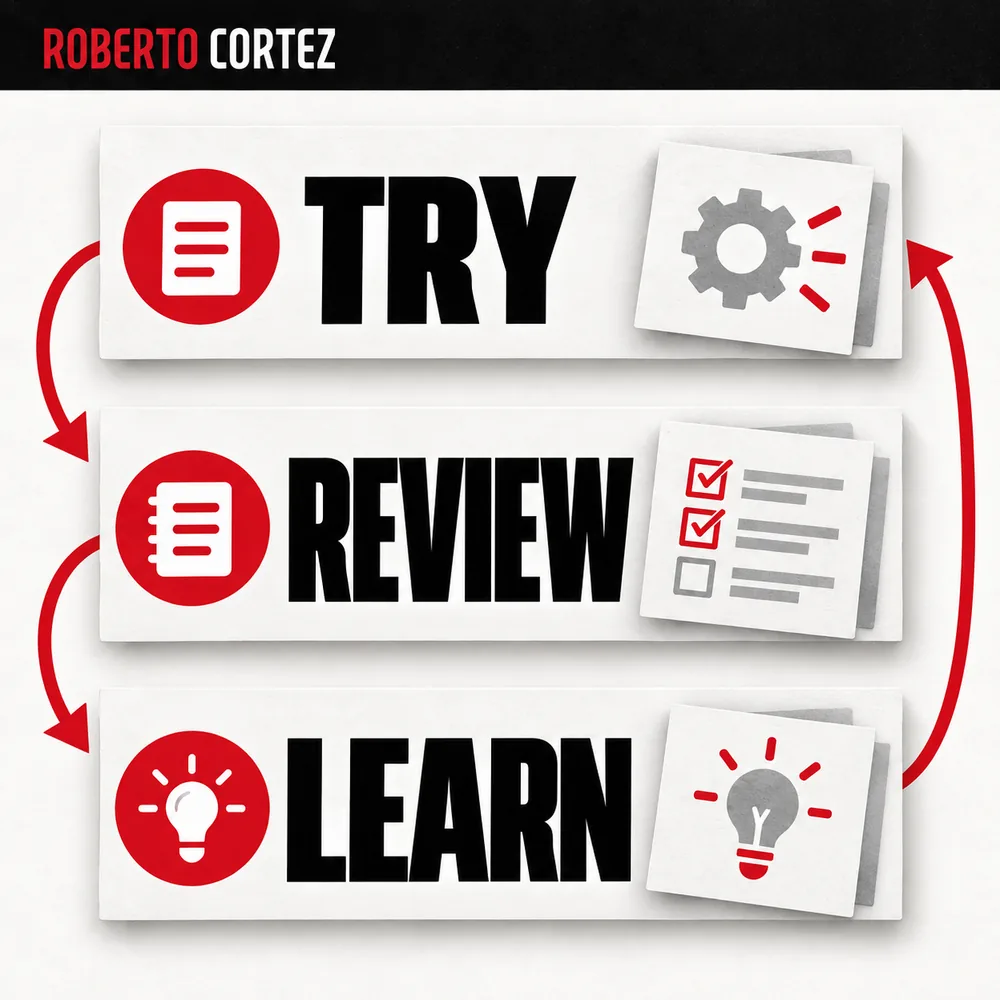
When information is insufficient, write “inconclusive” and explain why. There may have been limited exposure, recording problems or simultaneous changes. These situations call for different decisions: improve measurement, reformulate the question or assess whether dedicating more resources is worthwhile.
Avoid replacing the initial objective with another simply because a favourable number appeared. An unexpected discovery may deserve attention and a test of its own. Record it as a new hypothesis, without using it to present an unanswered question as resolved.
Finish with a decision and a record another person can understand
The closing record should state what was tested, what happened, what you can conclude and what happens next. Keep the limitations and remaining questions too. A useful record allows another person to understand the decision without depending on the memory of whoever followed the experiment or participated in the original discussion.
I would use a short record covering the question, change, period, resources, observations and decision. I would add links to the necessary records, avoiding copying information without context into multiple documents. If someone disagrees with the conclusion, they should be able to identify the observation or assumption they are discussing.
This care continues in recording lessons when a campaign ends. The difference is that preparation begins before execution: define what you want to discover beforehand, rather than trying to reconstruct the entire reasoning at the end.
Continuing, changing or stopping are all possible decisions. Choose the next action according to the available information and the cost of resolving what remains uncertain. The test has served a purpose when it makes that choice better informed, even if the original idea has become less convincing.