

Identify what the customer already knows before arriving
Before choosing a channel, understand whether the customer recognises the problem, knows a solution category and is looking for a supplier. These situations require different messages and next steps. The useful question is what remains to be understood or decided, rather than simply which platform the person spends most time using.
Imagine two hypothetical business services. Someone replacing broken equipment may immediately search for an available supplier. Someone losing hours copying information between systems may not yet know that there is a practical way to change the process, despite experiencing the difficulty every week in their work.
In the first case, responding to existing demand may be a natural starting point. In the second, showing the situation and explaining a possible intervention may open the conversation. These describe journey hypotheses, rather than guaranteeing that any campaign on either channel will work.
Start with the questions and expressions customers use, sales conversations and the actual offer. The diagnosis before proposing a marketing plan should clarify this point. Without it, channel choice may merely reflect the tool with which the team feels most comfortable working.
To prepare your next step, explore Lead generation for service businesses.
Use search when you can answer relevant intent
A search campaign can present adverts to people looking for related products, services or information. The opportunity depends on how relevant that demand is to your offer. Available searches do not mean every query expresses purchase intent or that advertising investment will be economically appropriate for the business in question.
A query about solving a problem may come from someone planning to do it themselves, compare options or hire assistance. The message and page need to address the most plausible intent while clearly stating what you offer. Buying visits without distinguishing these situations can generate activity with little commercial usefulness.
The match between demand and delivery capacity matters too. If you advertise a local service, confirm that you can serve the areas and conditions implied by the message. If the offer requires discovery, the next step should explain that process rather than suggest an immediate purchase that is unavailable.
Assess demand, competition and cost using information relevant to your case instead of treating the industry as an automatic answer. An existing search market justifies investigation and testing. Follow the outcome through to opportunity quality and the contribution of the sales you can actually confirm.
Use discovery to make a situation understandable
When someone is not yet searching for the solution, communication can begin with a recognisable situation and explain why it deserves attention. On social platforms, a message can be encountered without an explicit search for the offer. That opportunity requires clarity, context and a next step suited to the interest generated.
For the hypothetical information-management service, an explanation could show where work is repeated and which questions to ask before automating it. You do not need to invent a crisis to justify the conversation. You need to make a real difficulty visible and demonstrate how your intervention addresses it.
Someone discovering the approach may need a demonstration, an example or an explanation of scope. Immediately requesting a substantial commitment may not match their current position. The next step should allow informed progress without turning initial curiosity into a misleading claim of commercial qualification.
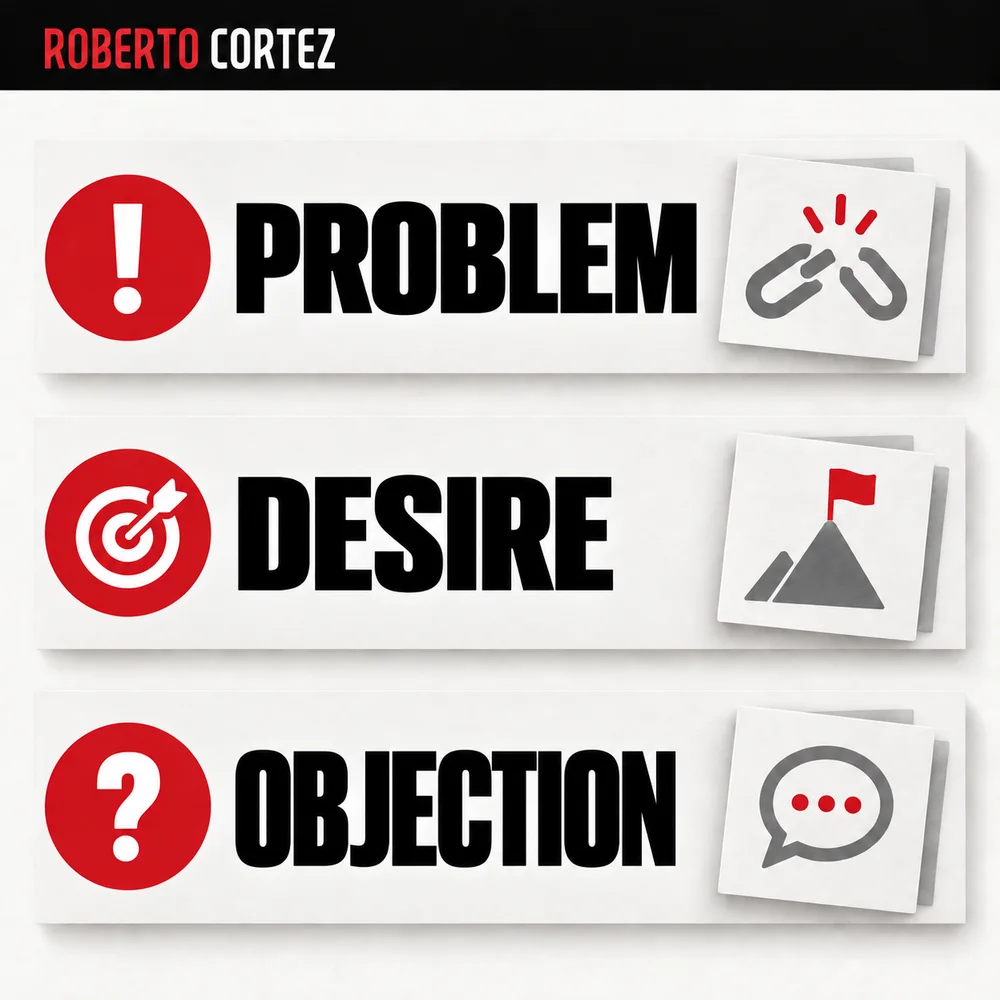
Use problem, desire and objection as different perspectives on the same offer. One message may help people recognise the situation; another may clarify the benefit or an implementation concern. This choice should reflect what the person needs to understand while preserving an accurate promise about the service.
Do not confuse the platform name with campaign function
The distinction between search and discovery helps planning, but does not divide platforms into exclusive compartments. Google offers formats beyond search, and someone on a social platform may already be ready to buy. Define the campaign's specific function and message before assigning it a role within the overall customer journey.
When someone says they will advertise on Google, you still need to know which type of presence they propose and which behaviour they expect to find. A search campaign and a video presentation can perform different functions. The advertising provider's name alone does not explain the strategy or required measurement.
Similarly, social platforms may introduce a new offer or reinforce a decision someone was already considering. Do not assume that every contact from one source shares the same awareness level. Look for signals in questions, interactions and the commercial progress that you can actually observe.
This precision also supports selling services in a competitive market. Differentiation needs to appear at the right moment: explaining a category may help someone unfamiliar with it, while a person comparing suppliers needs to understand your scope, process and suitability for their particular situation.
Compare channels across the complete sales journey
To compare investment decisions, follow cost, enquiry quality, time to sale and contribution generated. Consider that channels may participate at different moments in the same journey. A last-contact report should not automatically erase earlier work, but neither does it establish the value of interventions for which adequate supporting evidence is absent.
A person may discover the company through content, search its name later and request contact after reading the page. The final record may highlight only one of those stages. Use available information to understand the journey while distinguishing observed parts from those that remain unknown.
Avoid adding results attributed by several platforms as though they always represented different customers. Reconcile sales with the commercial system and examine the known origin of enquiries. Measurement should support decisions proportionate to the evidence, without promising to identify every reason that contributed to a purchase.
Designing a funnel the sales team can actually work makes this comparison more useful. If one channel produces contacts requiring education and another brings specific requests, follow-up must recognise that difference before concluding that one source generates lower-quality opportunities.
Allocate investment around the main uncertainty
Choose where to begin through the combination of relevant demand, offer clarity, message-production resources and capacity to follow opportunities. Define a hypothesis and a limit for the experiment. Budget allocation should develop with learning instead of copying fixed percentages or the channel choice made by an entirely different business.
If suitable demand exists and you can answer it well, starting with that opportunity may make sense. If the main obstacle is limited understanding of the solution, a discovery experiment can reveal whether the message opens conversations. Either decision needs criteria for continuing, correcting or stopping the work.
With limited resources, avoid splitting investment across so many channels that no hypothesis receives sufficient attention. Choose the most important question and prepare the corresponding page and follow-up. Expansion into another channel can come later, with a clear reason and the ability to interpret what it adds.
The plan should explain whom you want to reach, what that person already knows and which advance you propose. Google and social platforms enter that decision as available means. The criterion remains the relationship between intent, message, offer and the commercial outcome actually observed.