
Start with the meaning of the counted action
Before reading a CPA figure, identify the action in its denominator. It might be a purchase, an enquiry or another event configured as a conversion. The column heading does not turn those actions into customers: you need to know what happened in the business after the recorded event took place.
If a campaign optimises for submitted forms, its cost per conversion corresponds to that advertising outcome. Some enquiries may be duplicates, others outside the service's scope, and others may never reach a conversation. A platform cannot turn all those contacts into sales simply because its report displays a conversion.
When the action is a purchase, also confirm whether you are counting orders or unique buyers. A customer who buys twice may generate two actions while remaining one customer. For acquisition measurement, you also need to understand whether that person had bought from you before.
Use explicit report labels, such as cost per enquiry or advertising cost per confirmed first purchase. That precision prevents arguments where marketing and sales seem to disagree about results when they are simply using the same word for different stages in the commercial process.
To prepare your next step, explore Lead generation for service businesses.
Define the scope of CAC before calculating it
A useful operational CAC divides defined acquisition costs by the corresponding number of new customers. That scope may include advertising, production, tools, sales work and commissions. Keep the rule visible and consistent, separating acquisition costs from the costs of delivering the service or looking after customers who already exist.
There is no benefit in presenting an apparently comprehensive number if you cannot explain how it was built. If someone spends part of the month selling and the rest managing projects, record the allocation rule. An acknowledged estimate is more useful than precision invented down to the last cent.
You can also maintain two views: advertising-only acquisition cost and acquisition cost including relevant sales effort. The first helps monitor campaigns; the second brings the decision closer to operations. Give them different names so that an improvement in one report does not conceal extra work in another department.
The same care applies to shared agencies, content and tools. Choose a reasonable allocation method and keep a note about its limitations. The objective is to compare decisions over time without quietly changing the boundary of included costs to make the reported outcome look better.
Follow an example from form submission to customer
In a hypothetical example, a campaign spends 1,000 euros and receives 100 enquiries. Advertising cost per enquiry is ten euros. If ten of those contacts become new customers, advertising costs one hundred euros per customer; adding sales costs changes the figure you should use to make a decision once again.
Suppose qualification, meetings and proposals associated with those contacts represent another 600 euros. Counting only these two components, observed acquisition cost is 160 euros per new customer: 1,600 divided by ten. The ten euros in the first report remain correct, but answer a very different question.
Now imagine another campaign produces fewer contacts for the same advertising investment, but generates the same number of customers with fewer unproductive meetings. Cost per enquiry may look worse while the fuller acquisition cost improves. This possibility justifies tracking quality and effort instead of automatically rewarding the greatest volume of forms.
The example does not provide an acceptable threshold for your business. That threshold depends on contract contribution, retention and the time needed to recover the investment. This is where the reasoning about how much you can pay for a lead becomes useful.
Respect the time between acquisition and closing
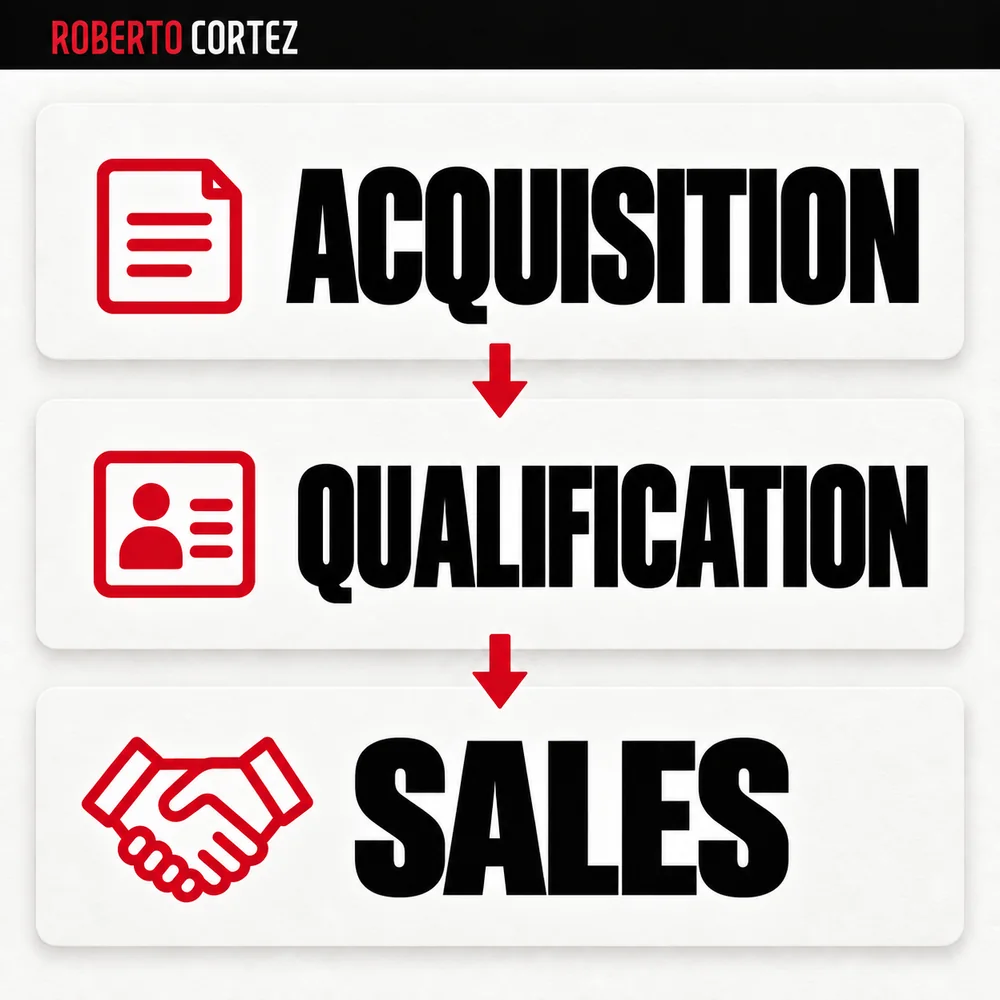
Today's costs may produce customers only later, especially in services requiring several conversations before a decision. Comparing all spending in one month with customers won during that same month can mix different generations of opportunities. Also follow groups of enquiries by their entry date and their subsequent progress through sales.
Imagine increasing advertising at the end of a month when proposals take several weeks to close. Monthly CAC may rise before those opportunities have had time to produce customers. Immediately concluding that the campaign has deteriorated would ignore a known part of the sales process.
The reverse happens too: a month with little spending can benefit from previously opened opportunities and appear exceptional. Keep the monthly view to monitor operational effort, but add a view by entry group. Indicate how many enquiries remain under consideration and when you expect to be able to revisit the conclusion.
You do not need to allocate every minute with perfect accuracy to begin. You need a rule that prevents comparing a newly arrived group with one whose process is complete. Explaining data maturity is part of measurement, just like explaining the event and reporting period.
Separate acquisition efficiency from economic quality
A lower CAC is a useful improvement only when the acquired customers maintain suitable economic quality for the service. Compare contribution, retention, delivery demands and receipts. A contract that is cheap to acquire may consume more resources or end early, reducing the value that appeared to justify the initial investment.
Do not apply a historical retention average to every segment without checking. Customers from an introductory offer may behave differently from those buying ongoing support. Comparison becomes more valuable when the source and offer are identified, even if the sample still requires caution in interpreting the results.
Keep accumulated revenue separate from the contribution left after delivery. A higher-value contract may require suppliers, travel or additional team hours. Recovering acquisition cost depends on the available share of that revenue and when it arrives, rather than simply the price presented in the proposal.
This connects with the indicators used to track business progress. CAC supports acquisition decisions when considered alongside delivery and continuity, without being expected to summarise the company's entire health on its own.
Use the difference to choose what to improve
When CPA and CAC tell different stories, identify the transition where cost increases. There may be unsuitable enquiries, slow responses, poorly aligned proposals or excessive sales costs. The useful decision is to locate that stage through data and observation, assign a specific improvement and monitor its effect on the following group.
If cost per enquiry stays stable while cost per customer rises, inspect progression rates and reasons for losing opportunities. Check whether the enquiry profile, response process or offer changed. Avoid automatically blaming the advert when the contact waited several days for a useful reply from the business.
If qualification requires too much work, review the message and initial questions before asking the team to hold more meetings. If proposals fail to close, examine discovery and the proposed scope. The starting point is understanding where sales are getting stuck, while preserving the relationship between stages.
End the report with a decision and an owner as well as the two figures. Knowing that CPA is ten euros and CAC is 160 euros can guide the next piece of work; calling both figures customer cost removes information that the team needs to use.