
Save what changes the next decision
Record information affecting how work should continue: objectives, boundaries, confirmed decisions, current results and unresolved questions. You do not need to copy the whole conversation to preserve context. Select what another session would need in order to proceed without reopening settled choices or repeating work that has already been completed.
Imagine building a portal for approving proposals. You have decided that only the sales manager can give final approval, the team prepares documents and customers receive only the approved version. Those rules affect subsequent changes and should be recorded outside the messages in which they were originally discussed and accepted.
In this hypothetical example, every attempted button name need not remain in the main summary. However, it matters that approval belongs to a specific role and content changes require another review. Select information according to its effect on the product rather than how much time you spent discussing it.
The principle of giving AI context with clear criteria applies to continuity too. A short record of verifiable decisions may be more useful than pages of conversation that mix suggestions, experiments and accepted choices. Keep detail where it can be consulted when there is a reason to retrieve it.
To prepare your next step, explore Developing applications with AI.
Separate project rules from task status
Stable rules describe how the project should work; task status describes where the work stopped. Keep those layers identifiable so that a temporary pending item does not become a permanent instruction. The plan can connect both, showing the objective, the decisions currently in force and the next step that has been authorised.
A rule might require public-facing text to be reviewed before sending. Status might say that a form is implemented locally but notification delivery still needs checking. Mixing those statements in an unstructured block makes it harder to distinguish what should remain valid from what will disappear once the task is complete.
The habit of planning an application before starting to code creates a basis for this separation. Keep requirements and decisions in the plan, point to the files guiding the agent and store execution results in a separate record. The structure can stay simple as long as each part has an understandable purpose.
Distinguish proposals from decisions too. If the assistant suggested adding payments but you have not accepted that feature, record it as a possibility. A later session should not receive a list of ideas and treat it as permission to implement everything simply because the earlier conversation ended without objections.
End the session with status that can be checked
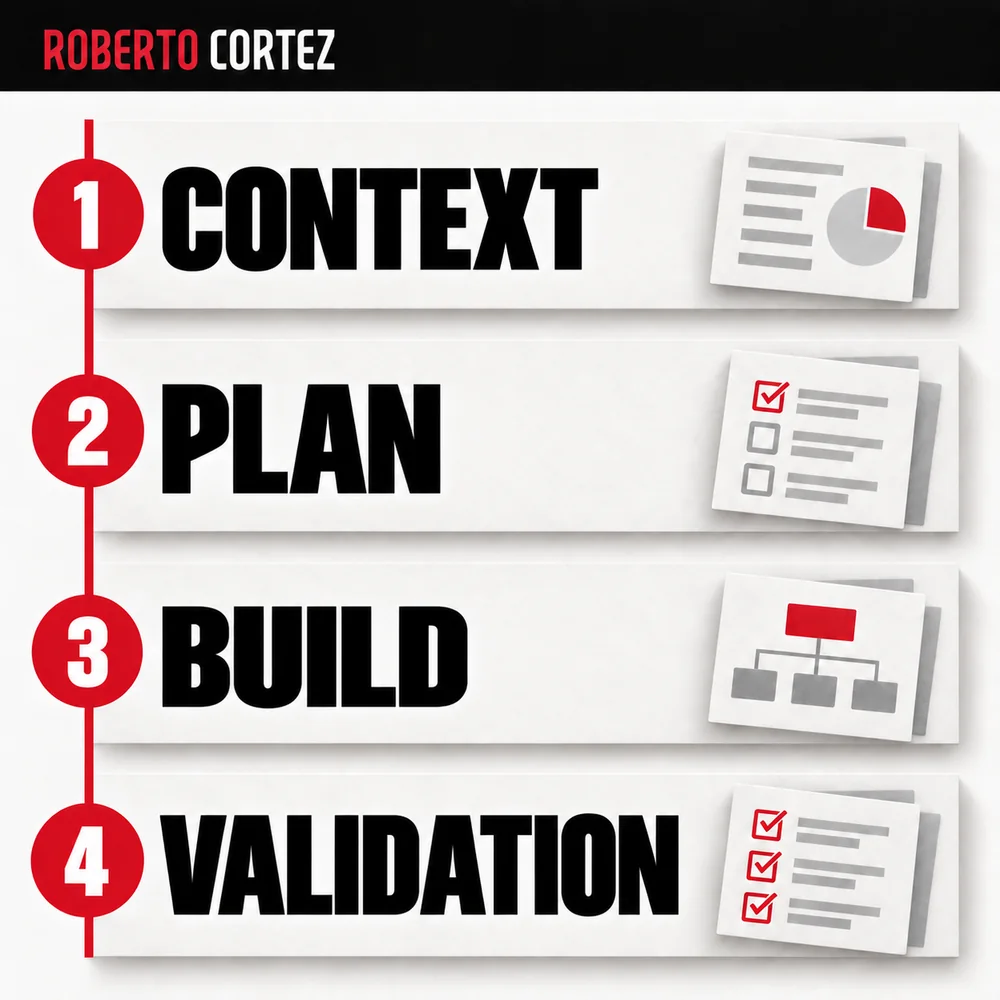
Before stopping, request a record of what changed, what was verified and what remains pending. Include result locations and known limitations. The summary should make facts checkable in the project, distinguishing implemented work from work that has been tested, approved or put into use by other people in the company.
The proposal portal's review screen might be ready while its permissions remain untested. Writing only that the portal is complete would give the next session unjustified confidence. A more useful description identifies the existing screen, the cases checked and the part that still needs to be evaluated before the system is used.
Save file paths, document names and version references when they are needed to locate work. Avoid copying credentials or customer data into the summary. Continuity depends on knowing where to obtain authorised access and consult relevant information, without turning documentation into an indiscriminate copy of everything the agent encountered.
If an attempt failed, record the known cause and remaining uncertainty. Every error message need not appear in the main document, but pointing to a saved technical result can help. The next session can then investigate without repeating exactly the same experiment because it did not know that it had already been attempted.
Resume by reading records and checking the actual project
At the start of a new session, identify reference documents and ask for their description to be compared with current files. Confirm the next task and its constraints. Available documentation helps recover context, but its existence does not demonstrate that it was read or that it remains accurate for the project.
Instruction loading depends on the tool and configuration in use. Do not assume that every file with a familiar name will be considered in every environment. Confirm which instructions apply and ask the agent to identify decisions relevant to the task before it starts changing the project or proposing new work.
Records may differ from reality because somebody worked in the meantime or an operation remained incomplete. Resolve that discrepancy before proceeding from the old summary. The document should guide investigation without automatically taking precedence over newer evidence that shows the project has reached a different state from the one recorded.
The preparation for a first working session still provides useful criteria for resuming: objectives, environment and access must be clear. The difference is that accumulated work now needs preserving. The new session should begin by understanding that work and identifying where it can safely continue.
Update the reference when a decision changes
When you change a decision, update the record guiding the work and mark the earlier rule as superseded. Preserve the reason where it makes sense to consult the history. Adding another sentence without resolving the contradiction can leave two incompatible instructions for the next session to interpret without enough guidance.
If final approval now requires two people, for example, the project needs to reflect that change in its plan and validation criteria. The historical record may explain the earlier decision, but should not present both as active rules. The team needs a clear reference for how the process currently works.
Review pointers and pending items too. A completed task should stop appearing as the next step, and a file that moved needs an updated reference. Small updates when changes happen prevent the continuity summary gradually becoming a description of a project that no longer exists in the form it records.
Useful documentation grows with the work, but is also simplified when context changes. Preserve decisions and evidence without making every session reconstruct the whole history. The criterion is whether the next task can resume with clarity about what is decided, what has been done and what still requires attention from the team.