

What should you record when a proposal is lost?
Record the need identified, the proposal presented, the reason the potential customer gave and the follow-up completed. Include the source of the enquiry and the decision date. If the reason is the team's interpretation, make that distinction clear so an assumption does not start directing campaigns as though it were a fact.
A label such as “lost” updates the opportunity's status. It does not explain what happened. And “poor-quality lead” can conceal situations as different as someone looking for another service, a proposal delivered late or a decision postponed because the customer lacked internal availability.
A useful record lets someone reconstruct the essentials without reading every message. Keep the customer's relevant wording, the context of the conversation and the next step that was agreed. Avoid judgements about the person's character: they do not help you choose a sales action or improve your communication.
Start with a few recent proposals that the team can review carefully. If you cannot even establish when the conversations stopped, diagnose where sales are stalling before multiplying the categories in your CRM. More completed fields cannot compensate for an incomplete account of the sales process.
To prepare your next step, explore The B2B sales process.
How do you separate price, trust, fit and timing?
Use categories that lead to different decisions and allow more than one factor for each proposal. A budget constraint can coexist with a lack of trust or a postponed priority. The main reason should reflect the best information available, while uncertainties and secondary factors remain visible in the record for anyone reviewing it.
Imagine a hypothetical case where the customer says the proposal is expensive. They might be unable to afford that amount, might not understand the work included or might be comparing different deliverables. Automatically lowering the price treats those three situations as though they were identical.
Asking what mattered most in the decision can clarify the difference, provided the person wants to answer. The intention is to understand, without turning a request for feedback into another persistent attempt to sell. A vague answer remains vague, even if the salesperson needs to select a category.
There are also cases of a genuine mismatch. If the service requires a team the customer does not have, the communication can explain that requirement better. If the solution does not address the need presented, marketing needs to review the expectation it created. In both cases, clearer information may be preferable to increasing enquiry volume.
Does silence mean the proposal was rejected?
Silence lets you record a lack of response, but it does not identify the reason for the decision. Distinguish an explicit rejection, an agreed postponement and an opportunity without recent contact. Each situation needs a coherent status and next step, even when all three are removed from the immediate sales forecast.
A proposal sent without agreeing when it will be reviewed may stall for reasons the team does not know. The recipient may need another person, have changed priorities or not have understood the next step. Choosing one explanation without confirmation creates certainty that the information does not support.
You also need to check the work completed. An opportunity followed up according to the agreed process differs from one that was forgotten. When everyone follows up in their own way, comparing campaigns through lost deals mixes acquisition quality with differences in sales execution.
Define when an opportunity should be closed and retain “reason unknown” where appropriate. A contact can leave the forecast without becoming permanently unsuitable. The work of turning leads into customers in a service business includes precisely this continuity between context, contact, qualification and decision.
How can you analyse reasons without misleading percentages?
Compare proposals that have had similar time to reach a decision, and show how many remain open. Among losses, separate confirmed reasons from unknown reasons. Include absolute counts too: a percentage can look decisive when it comes from very few conversations or only from the people willing to explain their decision.
Consider a hypothetical example with twenty closed proposals: eight won and twelve lost. Among the twelve losses, five customers mentioned price, three mentioned timing and four gave no reason. Price accounts for five of twelve losses, about 41.7%, or five of eight losses with a known reason, 62.5%.
Both calculations are mathematically correct, but they answer different questions. Neither allows you to say that 62.5% of all potential customers reject the price. Nor does either demonstrate that a discount would recover those sales. The group that replied may differ from the group that stayed silent.
If another ten proposals remain open, show that count separately. Do not directly compare an older campaign with completed decisions against one whose proposals went out yesterday. Record changes in the offer, price and follow-up too, so you can understand what changed between groups. An association between campaign and loss reason is a clue to investigate, not isolated proof of causation.
How do you feed the learning into campaigns and the offer?
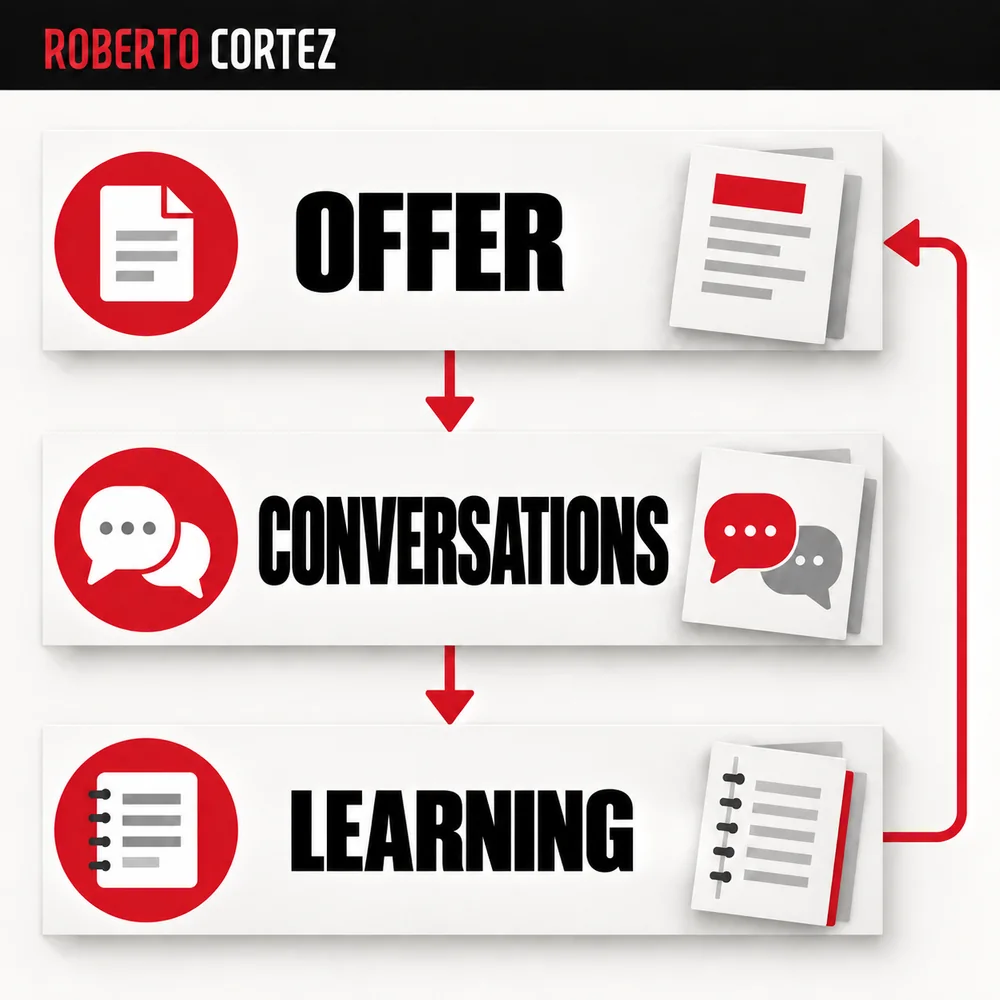
Turn an observed pattern into a specific change, with a hypothesis and a way to assess it. That might mean clarifying an exclusion, explaining a deliverable or presenting relevant evidence. Keep the connection between the reason identified and the change proposed, so sales feedback leads to an observable change in communication.
If several people expected a service the company does not provide, review the ad and page that created that expectation. An explicit sentence about scope may help prevent the confusion. If the doubt only appears after the proposal, the information may be missing or unclear at that stage.
When the concern is trust in delivery, find real evidence that addresses it: an explanation of the process, clear conditions or authorised examples. Do not invent testimonials to fill a gap in evidence. If the difficulty is the customer's ability to implement, decide whether qualification or the offer itself needs to change.
To explore different messages, you can prepare ad variations with AI from concrete hypotheses. Give the tool a summary without unnecessary personal data and check that each variation remains faithful to the service. A recorded objection provides context for thinking; it does not authorise promises the business cannot fulfil.
Who should monitor the results of the changes?
Marketing and sales should jointly choose the change, the person responsible and the review date. Monitoring should cover the quality of conversations, proposals and decisions, alongside the enquiries generated. If volume or observation time is still insufficient, keep the hypothesis under review instead of declaring that a lasting improvement has been established.
A short meeting can begin with losses supported by concrete information and cases where the teams disagree on classification. The aim is to reach a shared reading of the case. If two people classify the same answer differently, resolve that definition problem before comparing results.
Choose a small number of changes at a time. Keep the previous message and the change date so you can relate proposals to what the potential customer saw. Monitor the sales effect too: fewer enquiries may be acceptable if they are a better fit, but that conclusion depends on volume, sales and the team's capacity to handle them.
The expected outcome of this routine is a better-informed decision, not a perfect explanation for every loss. Some proposals will not progress, and some reasons will remain unknown. Even so, separating facts, interpretations and process failures helps you improve what the team can control without attributing every lost sale to the campaign.