

Define the decision the score will support
Before assigning points, define what changes when a lead receives a particular classification. Ordering contacts, requesting additional information and rejecting an opportunity are different decisions. The greater the consequence of the score, the more important it becomes to understand data quality and provide a way to review uncertain cases.
A ranked list helps a team with limited capacity choose where to start. A rule that automatically removes every contact below a threshold can prevent the business from discovering needs it does not yet understand. The same score should not receive both responsibilities by default.
In a hypothetical example, a business sells help with organising sales operations and favours companies with their own sales teams. A company without that team might look unsuitable, yet be looking precisely to establish its process before hiring. The signal only makes sense when related to the service and the specific need.
I would start by writing down the permitted use of each classification. A low priority indication might justify a clarifying question or a later review. It should only justify exclusion when the rule and the evidence support that decision, without replacing missing information with a convenient conclusion.
To prepare your next step, explore Sales automation with AI.
Distinguish missing information from a negative answer
Missing information does not demonstrate that a company lacks a particular characteristic. It may mean the form did not ask, the research failed or the source is outdated. Preserve these distinctions in the record and let the team confirm what is missing before treating an absence as a reason for rejection.
If the website does not show team size, the system has not discovered how many people work there. An empty field also does not automatically tell you whether the person declined to answer or encountered a difficulty. These situations need different treatment from an explicit answer confirming incompatibility.
The work of qualifying opportunities before making contact depends on this distinction between research and confirmation. Research prepares the conversation; it cannot replace every detail that only the company itself can clarify. Keep the origin and date of information when they matter to the decision.
In a hypothetical example, a contact uses a personal email address to request professional help. You may want to confirm the company and that person's role, but the email domain alone does not prove that the enquiry has no value. The next question should resolve the specific uncertainty raised by that signal.
Review what your criteria actually represent
Each criterion should have an explainable relationship with service suitability, need or the conditions required to proceed. Avoid adding points simply because a piece of information is easy to collect. Ask what assumption you are making and what evidence would reveal whether it is excluding opportunities that deserve a conversation.
Having a recent website, publishing frequently or using a particular tool may look like signs of maturity. Those characteristics alone do not confirm budget, urgency or interest in your proposal. They may also favour businesses resembling those you already know, consistently leaving other profiles outside your analysis.
If you use a score from zero to one hundred based on internal rules, do not present it as a purchase probability. Eighty points do not mean an eighty per cent chance of closing. That interpretation would require its own validation using observed outcomes under comparable conditions.
Separate essential conditions from preferences too. A need your service cannot meet is different from a company smaller than your usual customer. The team should be able to explain the difference without hiding behind the number, especially when the system proposes ending a conversation before understanding the enquiry.
Examine opportunities that were left out too
Evaluating only leads approved by the system makes some selection errors invisible. Set aside a proportionate review of rejected or deprioritised cases and try to understand the reasons. Where legitimate sales follow-up exists, compare the initial classification with later confirmation, without assuming that contacts you never approached would not have bought.
Imagine, as a hypothetical example, that every highly scored lead receives prompt contact and several follow-up attempts. The others receive no response. If the first group buys more, that could reflect both selection and the different treatment; the comparison does not isolate the effect of the score.
To learn, record when contact happened, what information was confirmed and what follow-up took place. Reviewing rejected cases does not require reopening every opportunity or persisting with people who do not want contact. It requires understanding the limits of what you can conclude from cases actually observed.
A small number of cases can reveal obvious flaws in a rule, but does not prove that one model is statistically superior. When turning leads into customers, both selection quality and follow-up quality need to remain visible. Otherwise, you may adjust the filter when the obstacle is at another stage.
Compare outcomes without hiding selection costs
A useful classification should help the team allocate its capacity better, considering opportunities, working time and economic outcomes. Do not judge the system only by the close rate among accepted leads. A very restrictive filter can improve that rate while reducing the number of suitable customers you are able to acquire.
In a hypothetical example, the team might close a higher proportion of a very small list and finish the period with fewer customers. That does not automatically prove the rule is wrong, because the effort required and delivery capacity also matter. It simply shows that the percentage alone does not answer the decision.
Connect this analysis with how much you can pay for a lead, making the included costs explicit. Sales time saved needs to be compared with the plausible contribution of lost opportunities. Do not treat all potential revenue as available margin or uncertain sales as realised results.
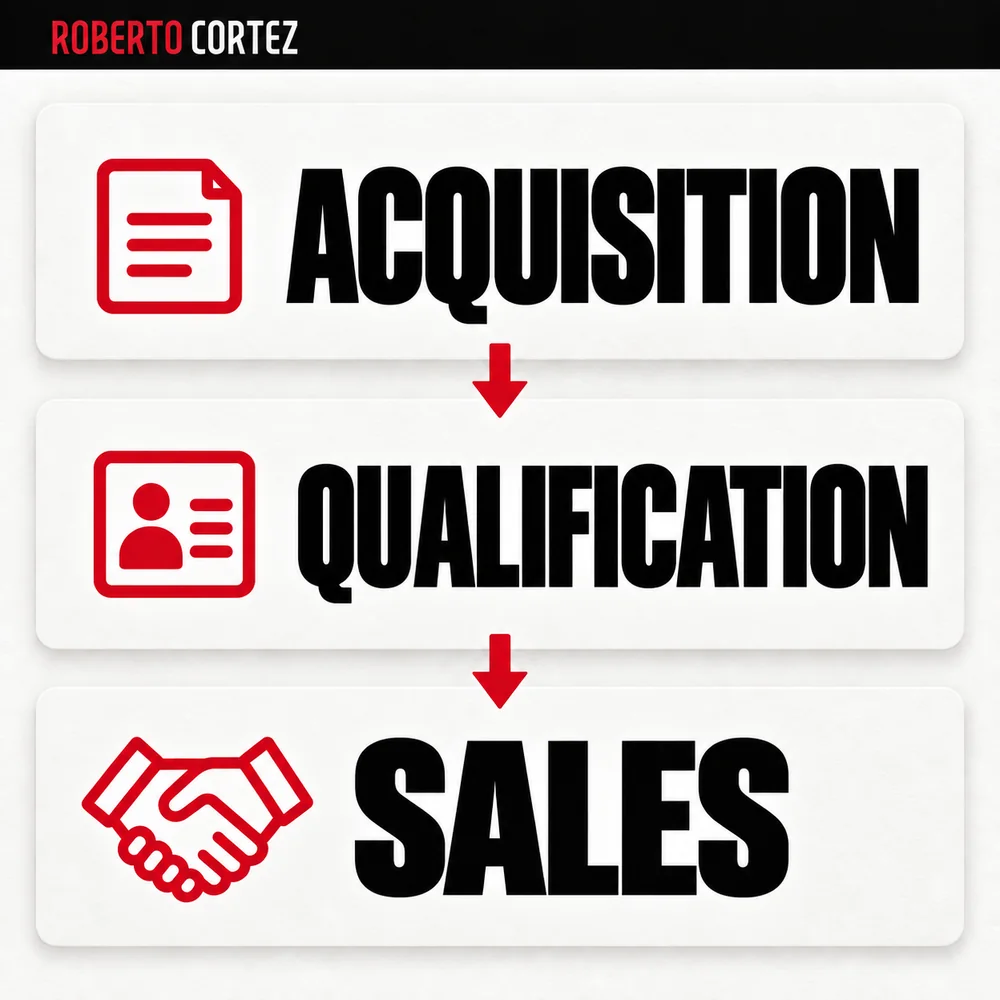
Compare groups that have had enough time to progress through the same sales cycle. A recent lead with no response is not necessarily lost. Keep open cases visible and explain whether you are measuring acquisition, qualification, a confirmed sale or payment received, because each outcome answers a different question.
Assign an owner and a version to the rules
Reviewing lead scoring requires an owner, identifiable criteria and a record of changes. Keep the version that classified each opportunity and the reason for any significant exception. This lets you understand whether a change improved selection or merely changed who receives attention and how the team records its results.
Do not change weights, the form and the contact routine simultaneously if you then need to understand each choice's effect. When several changes must happen together, record that limitation in the comparison. You can observe the practical usefulness of a change without inventing a causal explanation the data cannot support.
I would ask the team for specific examples of classifications that made no sense and compare those examples with the existing rules. An exception should not depend on someone's ability to insist; it should create learning that can benefit the next process. Then decide whether to change the rule, gather missing information or retain the incompatibility decision.
A scoring system becomes more useful when it helps decisions and lets you explain why they were made. Preserve the ability to correct data, confirm needs and reconsider conclusions. The aim is to allocate sales capacity better, including recognising opportunities that the first version of your assumptions could not yet identify.