
A conversation with AI can produce many options without resolving the choice between them. You may finish with different plans, arguments for each direction and little clarity about what actually depends on your business. Preparing for mentoring starts by organising that distinction between possibilities and concrete conditions.
I value being around people who ask questions, disagree and help review an idea. That outside perspective can be useful, but it needs enough context to understand what is at stake. Another person's experience does not remove the need to check what applies to your own situation.

Write down the decision blocking the next step
Start with a question that requires a choice or a concrete investigation. Explain what you want to achieve, why you need to decide and what happens while the decision is postponed. A focused question helps use the session to examine criteria, rather than moving through the entire business without reaching a useful conclusion.
“How do I grow the company?” can open a conversation, but it does not yet show where you need help. In a hypothetical example, the decision might concern improving follow-up of existing opportunities or finding more contacts. The question becomes more useful when you explain available sales capacity and what happens to incoming enquiries.
You do not need to arrive with a completed diagnosis. Your question may be precisely about identifying the main obstacle. In that case, explain what made you suspect each possibility and which information you still lack to distinguish them, instead of presenting your preferred explanation as an established fact.
For someone starting a business with AI, it helps to separate decisions about the offer, acquisition and execution. Trying to resolve everything in a single question can hide important dependencies. Choose the next commitment you need to make and use it to focus the conversation on what matters now.
Separate facts, interpretations and AI suggestions
Prepare a summary that distinguishes what you observed, what you conclude and what the tool suggested. Indicate the source and period of relevant data. If a statement has not been confirmed, keep that condition visible so the conversation does not treat a persuasive hypothesis as a description of what is happening in your business.
In a hypothetical example, you know several enquiries arrived but do not have a complete record of follow-up. AI may suggest that your price is too high. That suggestion does not become a fact because it appears in a detailed plan; it still needs checking against conversations, proposals and reasons for declining that you actually know.
The work of giving AI context without overwhelming it with information also helps prepare the session. Choose information that changes how the decision is interpreted. A short summary with clear definitions can be more useful than an extensive history mixing figures from different periods without explaining the difference.
Avoid sharing personal data or confidential information that is unnecessary to discuss the problem. You can use aggregated figures, clearly identified fictional examples and process descriptions. When a real document is essential, confirm access and sharing conditions beforehand rather than automatically placing it in a group where more people can see it.
Show the alternatives and why you are hesitating
Bring the options you are considering and explain the criteria used to compare them. Identify the expected benefit, resources required and uncertainty of each path. Mentoring can help question those assumptions, but the discussion becomes more concrete when you can show why you have not yet chosen one of the alternatives available to you.
You do not need every answer the tool produced. Select the options you would actually consider implementing and summarise what changes between them. If two proposals use different words for the same action, combine them before the session so you do not spend time comparing a difference that exists only in presentation.
In a hypothetical example, AI suggests creating an internal tool or adapting a process in software the team already uses. The decision may depend more on maintenance, access and how often requirements change than on the first prototype's appearance. Explain which of those conditions you know and which you have merely estimated.
It is also useful to say what would change your mind. That might involve discovering a missing integration, someone's lack of availability or a problem that occurs less often than expected. The conversation can then seek information relevant to the decision rather than defending whichever option appealed to you first.
Bring an attempt that can be examined
Where appropriate, show a small attempt and explain the outcome you expected and what happened. It might be a draft, a mapped process or a test using fictional data. The aim is to provide concrete material for review, without taking unnecessary risks simply to arrive at the session with something already put into practice.
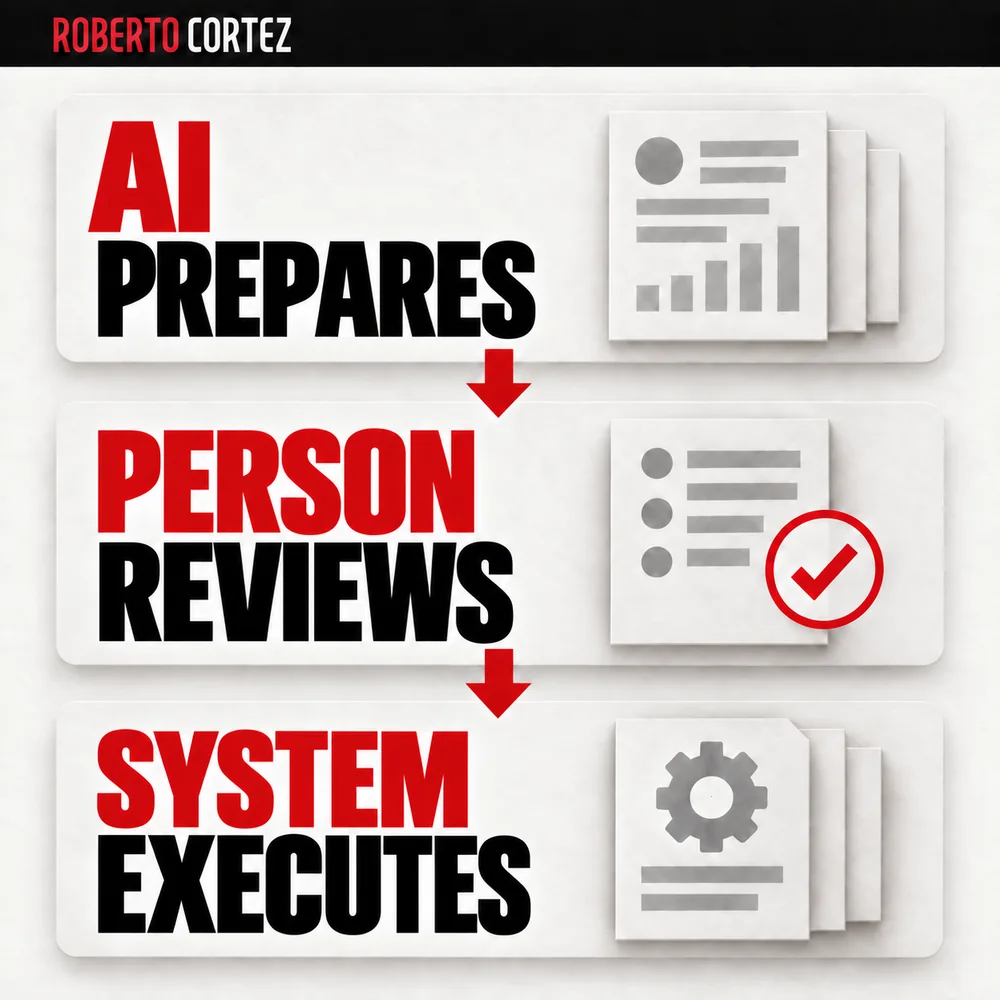
An incomplete attempt may be enough to reveal an important question. In a hypothetical example, you mapped the stages of responding to an enquiry and discovered that nobody was responsible for confirming delivery. That finding allows a specific responsibility to be discussed without building a complete automation first or involving real customers in a test.
This connection between a suggestion and actual work is part of using AI in business beyond the chatbot. A well-presented answer does not automatically show that the solution works with your team. An attempt helps reveal the data, people and conditions on which the proposal depends.
If you could not try it, explain why. A decision, access, basic knowledge or simply reserved time may be missing. That information is useful too, provided it is not hidden behind an AI-produced document describing work as complete when it has not yet happened in the business.
Leave with an action and a way to revisit the question
At the end, record what you decided to do, who will carry it out and what evidence you will seek. If the conversation does not support a decision, define the missing information and how to obtain it. A session can reduce uncertainty even when the best conclusion is to prepare a test before proceeding.
Distinguish a suggestion received from a commitment made. You can hear an interesting perspective and conclude that you do not yet have the conditions to apply it. Explain that limitation and seek an appropriate step instead of noting a list of actions that exceeds the business's capacity to act on them.
Responsibility for execution does not automatically transfer to the person guiding you. Confirm that you understood the conditions of a recommendation and ask for clarification where needed. An experienced person may also be unaware of an important detail in your context, so the conversation should allow assumptions on both sides to be corrected.
Keep the decision summary and bring the outcome to the next session. Show what you did, what you observed and what changed since the previous conversation. This allows mentoring to accompany a learning process rather than restarting every time with new AI answers to the same unresolved question about your business.
To prepare your next step, explore Individual business mentoring with Roberto Cortez.