

A list of skills tells potential clients what you can do, but asks them to imagine how it applies to their situation. Websites, content, advertising and automation may be part of delivery. Your presentation should explain why they might need those things and which work you are prepared to take responsibility for.
What is the first question to clarify?
The first question is which concrete situation leads someone to seek the service. Describe the problem through what happens in the business and the decision still to be made. Avoid starting with tools or a task list, because those choices become meaningful when there is a need the client recognises in their own situation.
In a hypothetical example, a provider presents their work as digital solutions for businesses. That phrase can include almost anything and leaves unclear when to contact them. If the focus is organising sales enquiries arriving through several channels, there is already a situation that can initiate a conversation.
You still need to establish whether the problem is lost information, slow replies or uncertainty over who follows each opportunity. Each hypothesis may require a different intervention. Choosing the central problem prevents a single promise from absorbing every difficulty you can imagine around that client and their business.
A diagnosis before proposing a marketing plan helps make that distinction. The initial message can be simple, but should come from understanding the work and the questions that remain unanswered before a suitable proposal can be prepared.
To prepare your next step, explore Positioning and value proposition.
How do you describe the recipient without false precision?
Describe recipients through characteristics that change the need or the way the service is delivered. Sector, team, process or business stage may matter, but need not all appear in the opening sentence. Choose criteria that help people recognise suitability and retain the others for qualification once a conversation about their situation begins.
In the enquiry example, having a team that distributes contacts among several people may matter more than operating in a particular sector. A company without a sales team may need another solution. That difference should guide the offer even if both describe themselves as service businesses.
Do not add a revenue or size threshold merely to make the message sound specific. If the criterion changes neither the work nor its viability, it may exclude suitable people without improving clarity. Useful precision has an operational or commercial reason that you can explain to someone considering the service.
Differentiation in a service market becomes stronger when it demonstrates fit. Saying you work for everyone with a personalised solution still leaves the whole interpretation effort with the reader, who must decide alone whether you can address their particular need.
How do capabilities become a clear intervention?
Connect capabilities with a sequence of work addressing the chosen problem. Explain what you will observe, organise, implement or support, and what the client must provide. The intervention should be concrete without overloading the presentation with tools, internal detail or a list of actions whose necessity you have not yet established for that case.
The example provider can begin by mapping incoming channels, defining owners and setting up a way to track enquiries. They then check with the team whether information reaches the right person. This description explains the work, whereas an expression such as digital transformation leaves many interpretations open.
Tool selection can wait until existing systems are understood. If the promise starts with software, you may try to fit every client into the same solution. The method should allow the conclusion that changing a process is enough, or that a dependency must be resolved before implementation can proceed.
Distinguish your work from the client's work as well. Providing access, validating criteria and answering questions may be essential. An understandable offer reveals that participation before purchase instead of presenting delivery as something that happens without any involvement from the company receiving the service.
How do you express a benefit without inventing a promise?
Express the benefit as the change the work aims to enable, distinguishing it from commitments you can verify directly. Organised information may improve enquiry follow-up, but cannot guarantee that everyone buys. The message should connect intervention with usefulness without turning a commercial intention into a numerical forecast unsupported by evidence for that specific client.
In the example, the proposal can explain that it aims to make each enquiry's owner and next action visible. That is more concrete than promising effortless sales growth. Verification can examine whether covered enquiries have an owner and whether the team uses the process that was agreed.
When previous results exist, retain their context and permission when presenting them. A case can demonstrate experience without promising repetition. Without evidence, describe the method and quality criteria instead of inventing percentages or payback periods that make the proposal sound stronger than the available information supports.
The value of a service when execution becomes faster also involves explaining responsibility. You do not need to exaggerate technical difficulty to make the work of diagnosis, decision-making and validation visible to the person considering your offer.
What does a complete rewrite look like?
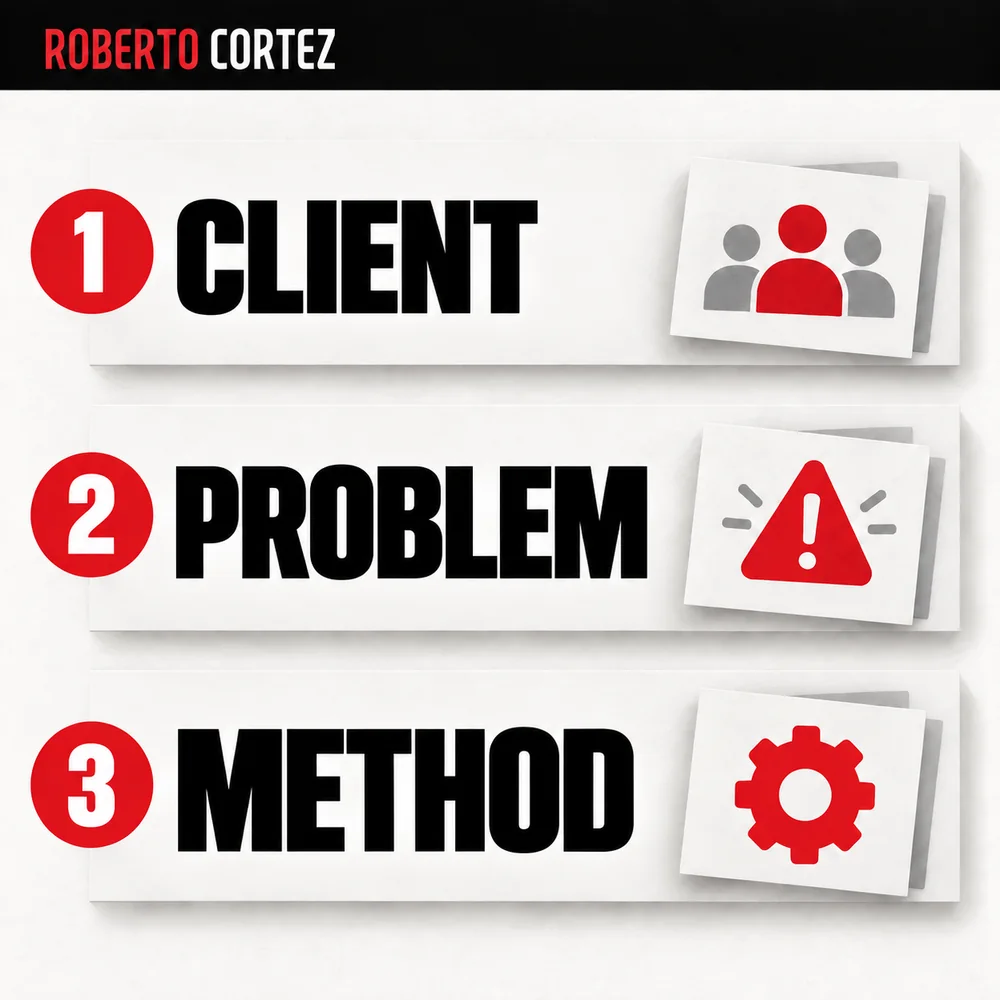
A useful rewrite combines problem, recipient, intervention and next step without trying to explain everything in one sentence. Present the central idea first and develop the conditions immediately afterwards. Readers should be able to identify the service and recognise what still needs confirmation before receiving a proposal suitable for their own situation.
In the hypothetical scenario, the original presentation was digital solutions for businesses. A revised description might be: I organise incoming sales enquiries and follow-up for service teams receiving contacts through several channels. The sentence identifies work and context without guaranteeing sales or requiring the reader to know a tool.
The following paragraph explains that work starts by understanding current channels, who responds and where continuity is missing. Responsibilities and a way to follow enquiries are then defined with the team. Scope, systems and subsequent support are agreed after that initial assessment of the situation.
This version is more specific, but still needs testing with suitable people. Clarity is not proved merely because the text sounds better to its author. A potential client may interpret a word differently or expect something that the description has not yet made explicit.
How do you check whether the offer became clear?
Ask people close to the intended profile to explain what they understood, whom the service suits and when they would contact the provider. Observe questions and unexpected interpretations before evaluating persuasion. A clear message enables recognition of fit or lack of fit; it need not convince everyone or remove the need for a sales diagnosis.
Avoid starting by asking whether they liked the text. A polite answer can conceal that they did not understand the service. Ask them to identify the problem, intervention and next step in their own words without first supplying the interpretation you hope they will give back.
If requests for different services emerge, review the wording creating that interpretation. If suitable people understand but have no priority, investigate the need and timing instead of adding adjectives. The offer improves when messaging, demand and delivery capacity become more closely aligned through concrete decisions about the actual service.