

It is easy to watch a task finish in seconds and imagine the same result repeated all day. That possibility deserves attention, but moving into the business introduces conditions the example may not show. The file was prepared, access was working and somebody knew exactly what the next step should be.
In everyday work, the process receives information from different people and needs to remain understandable when its author is absent. A demonstration is valuable because it shows a concrete possibility. The decision to use it regularly requires understanding which parts are already prepared for the actual conditions of the work.
The chosen example may hide the variety of the data
A demonstration usually shows a limited set of inputs, while the business receives different formats, levels of detail and situations. Establish whether the example represents routine work or only the simplest case. Data variety must be part of the assessment, especially when it changes the interpretation or the result that people expect.
Imagine an automation that reads commercial enquiries and prepares a summary for the team. In the example, the message identifies the service, deadline and responsible contact. In subsequent enquiries, somebody sends only a photograph, another person refers to an earlier conversation and a third combines two different needs in the same text.
In this hypothetical example, the ability to produce the first summary does not establish how the system handles missing information. It may need to ask for clarification, separate requests or pass the case to a person. The process remains useful if it recognises those limits and makes them visible.
Choose examples representing normal variety, including cases the team finds difficult. Avoid using only the most organised documents to make a decision about a routine that rarely receives them in that form. The difference between ideal inputs and frequent inputs is part of the work you are trying to solve.
To prepare your next step, explore Assessing business readiness for AI.
Connections between systems have their own conditions
An integration exchanges information between tools, but the process also depends on the content received, the timing of the response and the available access. A successful connection confirms that particular execution under the observed conditions. For regular use, establish what happens when a dependency is delayed, changes or stops responding as expected.
In an application that collects sports results and updates standings, obtaining a value is different from knowing that it is ready to use. The result may not yet be final, or necessary information may arrive later. The application's logic needs to distinguish those situations before updating what it displays.
The same reasoning applies to an order, a payment or a change in commercial status. Receiving a response from another system does not remove the need to check what the data means. Technical confirmation of communication and confirmation that the process can proceed answer different questions about the same operation.
This distinction helps explain when automation needs AI and when rules are enough. A rule can check a defined status; AI can interpret free text. Neither choice removes the need to recognise incomplete information or a dependency that still needs confirmation before the next action can safely take place.
The author's intervention may be hidden in the result
Observe how much work happened before, during and after the visible part of the demonstration. Preparing files, correcting fields or manually choosing the right case may be necessary to obtain the result. Make those interventions explicit so the business knows what will continue to require a person's time during routine use.
The person who built the automation knows its details and may resolve a difficulty almost without thinking. They may choose the correct file among similar versions, fill in a missing field or repeat a step after noticing an error. To an observer, everything appears to belong to one continuous sequence.
Ask for the path to be explained from the arrival of the request to a usable result. Include preparation and final checks, even when they happen in another tool. The objective is to understand the complete process and what needs to be taught to the people who will use it.
If the team permanently depends on the author to recover an execution, that dependency belongs in the decision. It may be acceptable during an initial experiment, but requires availability and supervision. Do not confuse it with a routine ready to operate without that support simply because the final result looks straightforward.
Finishing an execution may not mean finishing the task
Define the result by the use the team needs to make of it, rather than technical completion of the workflow alone. A generated file can be incomplete, a prepared message can still need approval and a created record can belong to the wrong customer. The task ends when the result meets the agreed delivery criteria.
In the commercial enquiry example, generating a summary is insufficient if the team cannot locate the original request or understand that an important condition is missing. A useful result may need to include the next responsible person, the information still to be confirmed and a way back to the original context.
Also distinguish drafting, reviewing and execution. A demonstration may end at the produced document, while the business process finishes only after somebody validates and sends it. Those stages introduce work and decisions that need to be included when you assess the benefit of the automation and the capacity required to operate it.
This is why planning an application before starting to code helps define what counts as complete. The specification should describe the result expected by the person using the tool, including the conditions for accepting the delivery and the situations that require somebody to intervene before work continues.
Turn the demonstration into a limited operational trial
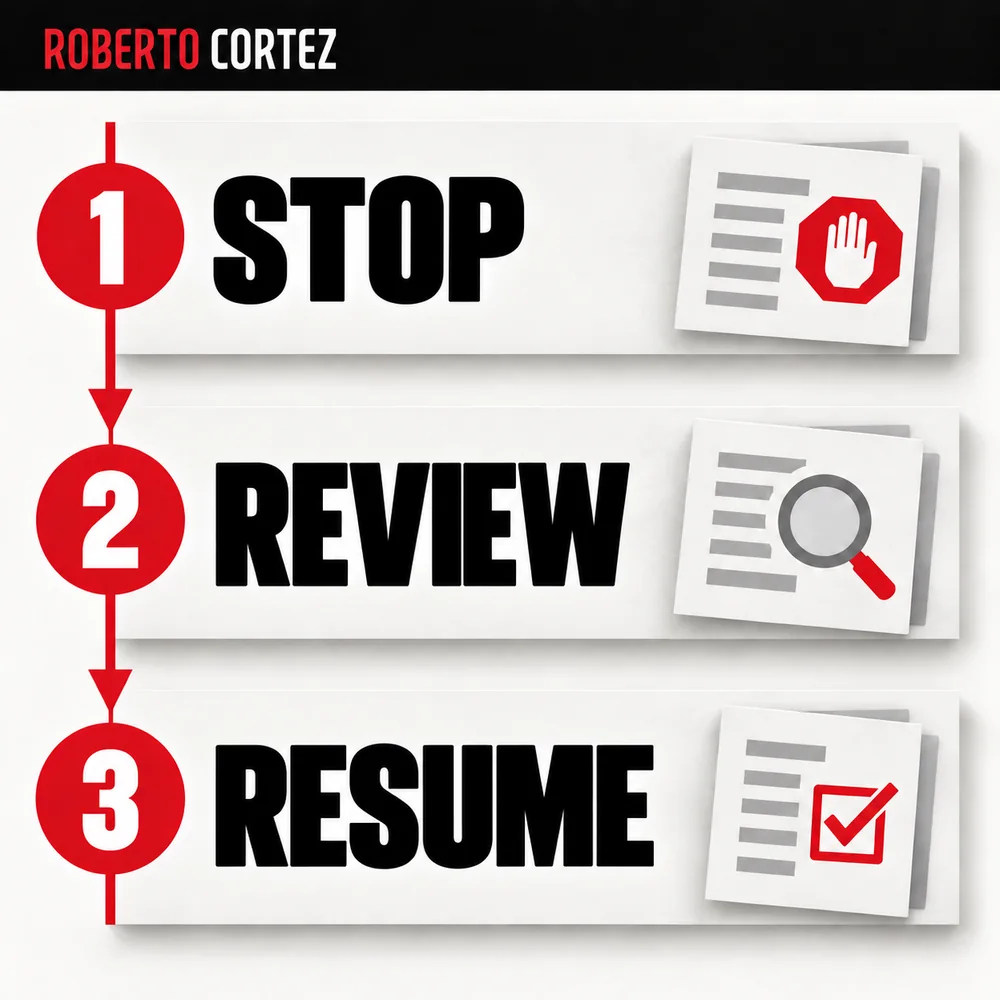
Before making the automation routine, use a limited set of representative cases with supervision and acceptance criteria. Define who participates, which actions are allowed and when the trial should stop. The objective is to observe the complete work, including exceptions and recovery, without assuming that initial success will repeat under every condition.
A limited trial reveals differences between the idea presented and the team's routine. Record completed cases, corrections and the questions raised by people using the process. Distinguish a learning difficulty from a limitation that requires changing how the system works, because the responses needed to address them are different.
The procedure for testing an automation before handing it over to the team develops that validation further. The key point here is that a demonstration and operations offer different evidence. One shows that a path is possible; the other reveals whether that path serves routine work under the conditions the business accepts.
At the end, decide what can already be used, what needs correction and what stays manual. A good demonstration may justify the next trial without yet justifying full adoption. Moving in stages lets you use the possibility that was demonstrated and build the missing parts needed to make it useful inside the business.