

While reflecting on my business journey, I asked an AI to ask me uncomfortable questions about these seven years of agency, info-products and mentoring work, and about the roughly five million euros billed over that period across SpartAds, other projects of my own. Several answers kept circling back to exactly this point: knowledge only matters once it is tested against the real friction of daily operations.
The agency began in 2019, after I had already been working in digital since 2012. The roughly five million mentioned in this reflection belongs to the assessment made then. The updated cumulative figure is €6 million in my own businesses, with the largest share coming from services and delivery.
The trap of endless training without application
Joining program after program without implementing anything gives a false sense of security and does nothing to fix the underlying commercial problem. I see this constantly: someone joins a mentorship, leaves, joins a similar one, and months later the results haven't moved.
In the interview I addressed this directly: a lot of people live in permanent training mode, jumping from mentorship to mentorship with the same unresolved challenges, never prioritizing execution of what they already learned. That saddens me, because it is wasted potential, genuine waste.
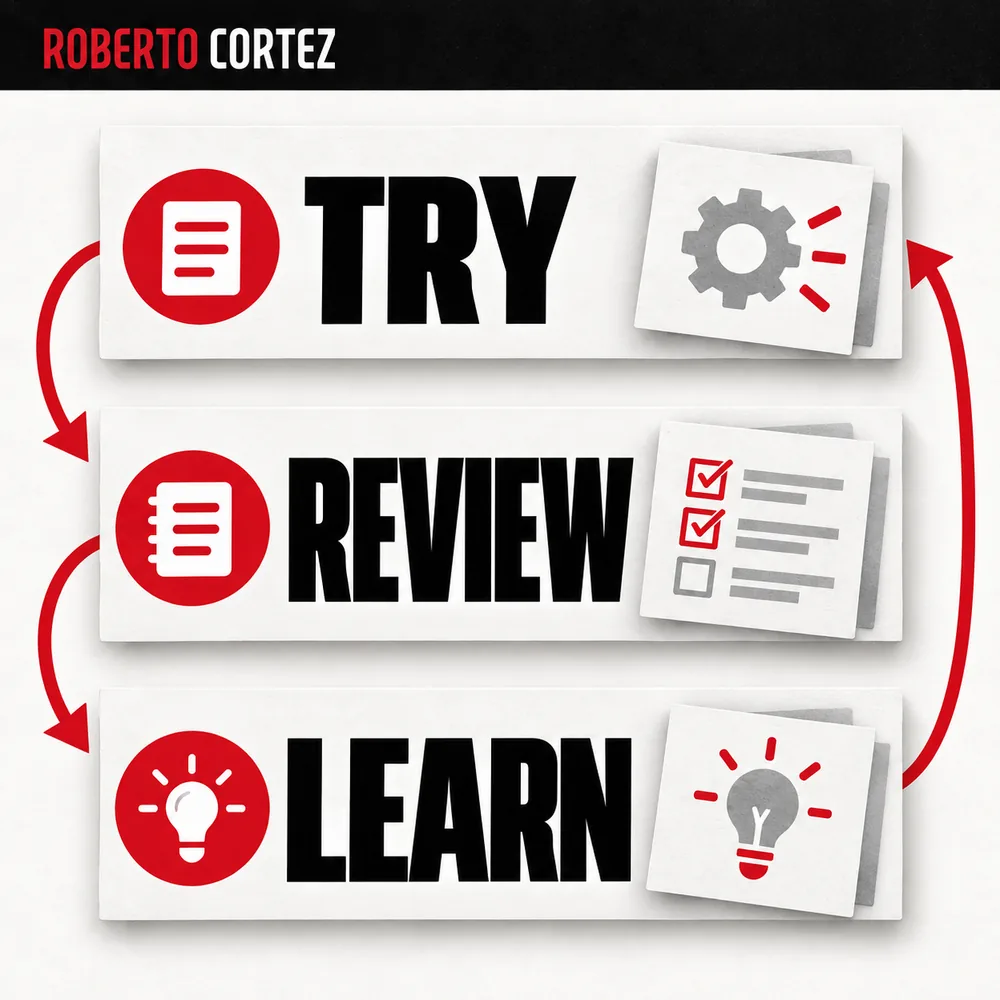
If you join a mentorship, bring a concrete goal: building a sales department, rewriting your sales page, learning to run ads. The rule I defend is simple: apply three times what you've already learned before going out to gather more information.
To see how these decisions connect to a business's financial health, it's worth revisiting the article on growing an online business while managing margin, team and processes.
To prepare your next step, explore My businesses, decisions and results.
Stop being the sales bottleneck yourself
When the founder concentrates all client contact, the business loses speed every time that calendar fills up. In the interview I answered directly when asked how much money I lost by being the bottleneck: a lot of money. During the period when I personally handled sales for the agency, I would sometimes take seven days to respond to a lead.
At the time I thought the deliverable was the only thing that mattered, that we had to bring maximum craftsmanship to the work, and that's still true. But I came to understand that the main department in a service business is sales.
Today, if we take seven minutes to reply, that's already considered slow. The difference didn't come from some trick, it came from removing myself as the center of every commercial interaction. That requires clear qualification criteria and a team prepared to act without waiting on me.
If you want to structure this flow, the article on building a lead funnel your sales team can actually work goes deeper into this.
Closing profitable projects to regain focus
Keeping a project alive simply because it still generates revenue is one of the hardest calls an entrepreneur makes. In the interview I gave the example of Prolancer, a mentorship program that had already run seven cohorts when I decided to shut it down, when it probably should have stopped at the fifth.
Giving up a cohort meant turning down something like 70 to 75 thousand euros that would have landed that month. In the short term it looked like a poor financial decision. But once I stopped putting my energy into other people's businesses and redirected all of it into my own, results exploded: this year we have no Prolancer and we're billing more than ever.
The lesson I take from this is that you should evaluate, project by project, whether each initiative still justifies the energy it consumes compared to what could grow in your core business, even when it remains profitable.
Gross revenue versus the margin that actually stays
Talking about revenue is easy, talking about margin is uncomfortable. In the interview I admitted this plainly: there were years when our priority wasn't profit, it was growth and gaining market share, and that happened consciously, not by accident. The problem isn't having a year without meaningful profit to accelerate processes.
In the interview I described a shift towards profit and better processes across the businesses. I said that, at that point, revenue was about 117% above the previous year without an increase in team size. This was a result I reported for that period in my own business. AI was part of that evolution alongside operational and focus decisions; I do not present that percentage as a promise for another project.
That productivity gain is what converts into real margin at month's end, not the vanity of announcing a gross revenue figure. To see how this applies to media buying work too, the article on what to expect from a media buyer in the age of automation and AI develops this point further.
Masterminds, travel and the tourism of knowledge
There were years when we invested more than 100 thousand euros in masterminds, international events and trips to Brazil, Mexico, Argentina and the United States. In the interview I was blunt: in Brazil, I mostly took a loss, because I often joined more out of vanity than real business need, wanting to meet people I only knew from Instagram.
We must be intentional about the specific benefit we seek from these groups. I remain in a mastermind in Portugal that makes sense for me, but I decline other invitations straight away. I stay focused on my business and have never made this much money, without chasing status.
Often the real value of those groups wasn't the information itself, it was that they forced you to stop and think about the business. If you can build that habit of pausing weekly with your team to review what's slow, you don't need to pay for a trip to do it. On using modern tools in that review process, the article using AI in business beyond the chatbot offers concrete ideas.